
Quick answer: Some of the most realistic passive income opportunities in 2027 include digital products, niche blogging, affiliate marketing, YouTube content, micro-SaaS, online courses, and long-term investing. These models allow you to build assets that can generate revenue repeatedly, but none are completely hands-free. Success depends on solving real problems, finding customers, managing expenses, and maintaining what you build.

Passive income is often presented as a simple formula: create something once and earn money forever. However, the actual process is more complicated.
A digital product needs customers. A website needs visitors. A YouTube channel needs useful content. A software product needs maintenance. Even an investment portfolio requires research and risk management.
The realistic opportunity is to create an asset that can generate revenue without requiring you to personally complete every transaction or deliver every unit of work.
For example, a digital planner can be sold to hundreds of customers without redesigning it for each order. A helpful tutorial can attract visitors months after publication. A small software tool can serve multiple businesses through recurring subscriptions.
This guide explores 12 passive income ideas for 2027 in detail. Instead of simply listing opportunities, it explains how each model works, how it makes money, what you need to get started, its potential expenses, and the challenges you should understand before investing your time.
What Passive Income Actually Means#
Passive income is revenue generated from an asset, investment, or business activity that does not require your direct involvement in every transaction.
The asset may be a digital product, website, book, video library, software application, or financial investment.
Consider these examples:
- A printable planner that customers can download after purchasing.
- A blog post that generates affiliate commissions from relevant product recommendations.
- A YouTube tutorial that continues receiving views.
- An eBook that sells through an online publishing platform.
- A subscription-based software tool that provides recurring value.
- An investment that may generate dividends or interest.
In each case, you perform work before or during the creation of the asset. Afterward, the asset can continue generating revenue with less direct effort per transaction.
However, ongoing responsibilities still exist. You may need to update products, maintain software, publish new content, respond to customers, or monitor investments.
Passive Income vs. Active Income#
Understanding the difference helps you choose the right business model.
| Income type | How it works | Example |
|---|---|---|
| Active income | You exchange your time directly for payment | Freelancing, consulting |
| Semi-passive income | You create an asset that can sell repeatedly | Digital products, eBooks |
| Recurring income | Customers pay repeatedly for continued access or value | SaaS subscriptions, memberships |
| Investment income | Your capital is invested in financial assets | Dividends, interest |
Many online business models are better described as semi-passive rather than completely passive.
For example, a freelancer who creates a website template and sells it repeatedly has moved from delivering a custom service to selling a reusable asset. The product still requires marketing and support, but each additional sale does not require starting from zero.
Why 2027 Is a Good Time to Build Online Income Assets#
Several developments make online business models worth exploring in 2027.
1. The creator economy continues to expand#
Businesses increasingly work with creators, publishers, educators, and niche communities to reach customers.
According to the Interactive Advertising Bureau’s 2025 Creator Economy Ad Spend and Strategy Report, U.S. creator advertising was projected to reach $37 billion in 2025, with a projection of $44 billion in 2026.
These figures represent creator advertising expenditure, not guaranteed earnings for individual creators. However, they demonstrate the growing commercial importance of online audiences and creator-led distribution.
Source: IAB Creator Economy Ad Spend and Strategy Report.
2. AI makes production and automation more accessible#
AI tools can help individuals perform tasks that previously required more time or specialized resources.
For example:
- Writers can organize research and create content outlines.
- Designers can explore product concepts and generate initial design ideas.
- Developers can prototype applications and automate repetitive tasks.
- Video creators can generate subtitles, voiceovers, and visual concepts.
- Business owners can automate repetitive administrative workflows.
However, AI does not automatically create a profitable business. You still need to understand your audience, produce useful work, verify information, and attract customers.
Google recommends creating helpful, reliable, people-first content. Publishing large amounts of low-value material simply to manipulate search rankings is not a sustainable content strategy.
Sources: Google’s people-first content guidance and Google’s guidance on generative AI content.
3. Digital distribution allows access to international markets#
You no longer need a physical shop to sell many digital products or services. Marketplaces, websites, video platforms, and email services can help creators reach customers in different countries.
However, international availability does not mean every payment provider or marketplace supports every country.
Before building a business around a particular platform, check:
- Seller eligibility in your country.
- Available payment and withdrawal methods.
- Transaction and subscription fees.
- Tax documentation requirements.
- Minimum payout thresholds.
- Refund and dispute policies.
- Restrictions on the products you can sell.
Payment availability should be part of your initial business research rather than something you investigate after launching.
12 Realistic Passive Income Ideas for 2027#
1. Sell Digital Products#
Best for: Designers, educators, creators, freelancers, and people who understand a specific audience.
Startup cost: Low
Skills required: Design, research, product development, and marketing
Time to first sale: Depends on product demand and distribution
Digital products are among the most accessible online business models because you create a downloadable resource and sell it repeatedly.
Unlike physical products, you do not need to manufacture, package, and ship every order. Customers receive their files digitally after purchasing.
What Digital Products Can You Sell?#
There are many possible product categories:
- Printable planners and calendars.
- Budgeting spreadsheets.
- Notion templates.
- Resume and portfolio templates.
- Social media content templates.
- Business proposal templates.
- Educational worksheets.
- Digital journals.
- Checklists and business documents.
- Website templates.
- Digital illustrations and graphics.
- Productivity systems.
- Industry-specific calculators.
The best products are not necessarily the most complicated. A simple resource that solves a specific problem can be more valuable than a large collection of generic files.
For example, a monthly budgeting spreadsheet designed for freelancers may be more useful to its target audience than a generic spreadsheet containing dozens of unnecessary features.
How Does a Digital Product Business Make Money?#
The process generally looks like this:
- Identify a specific audience.
- Find a problem that audience wants to solve.
- Create a digital resource that addresses the problem.
- Publish it on a marketplace or your own website.
- Attract relevant visitors.
- Convert visitors into customers.
- Improve the product using customer feedback.
Suppose you create a digital planner and sell it for $8.
If 50 customers purchase it during a month:
| Metric | Example |
|---|---|
| Product price | $8 |
| Number of sales | 50 |
| Gross revenue | $400 |
| Marketplace and payment fees | Deduct separately |
| Advertising expenses | Deduct separately |
| Final profit | Depends on actual costs |
This is an illustrative calculation, not a sales forecast.
The advantage is that the same digital file can be delivered to multiple customers without recreating it for each order.
Where Can You Sell Digital Products?#
Some popular options include:
- Etsy – Marketplace for printable products, templates, artwork, and other digital downloads.
- Gumroad – Platform for selling digital products directly.
- Payhip – Digital storefront with product delivery and other selling features.
- Your own website – Provides more control over branding, customer experience, and product presentation.
Platform availability, payment support, and seller fees vary. Verify the current terms before selecting a platform.
Understand Digital Product Fees and Profit Margins#
A common mistake is calculating revenue without considering marketplace and payment fees.
For example, Etsy’s published fee structure includes a $0.20 listing fee and a 6.5% transaction fee. Payment processing and other applicable charges are additional and can vary by country and transaction.
Official reference: Etsy seller fees.
Before choosing your selling price, consider:
- Listing fees.
- Transaction fees.
- Payment processing.
- Advertising costs.
- Refunds.
- Design and software expenses.
- Applicable taxes.
A product that sells frequently is not necessarily profitable if its price is too low or its advertising cost is too high.
How to Create Your First Digital Product#
Step 1: Select a specific audience
Avoid targeting everyone. Choose a group such as teachers, students, freelancers, small businesses, or content creators.
Step 2: Research customer problems
Look at existing products, reviews, discussions, and frequently asked questions. Identify what customers like and what they believe is missing.
Step 3: Create a focused product
Start with one useful product rather than a large bundle of unrelated files.
Step 4: Test everything
Check formatting, file compatibility, instructions, download links, and product quality.
Step 5: Create professional previews
Customers cannot physically inspect a digital download. Product previews should clearly show what they will receive.
Step 6: Publish and promote
Use marketplace search, Pinterest, relevant communities, social media, and your own website where appropriate.
Step 7: Analyze and improve
Track visits, clicks, conversion rates, customer questions, refunds, and actual profit.
Common Mistakes#
- Publishing generic products without a clear target audience.
- Copying popular designs instead of creating original work.
- Creating many products before testing demand.
- Using misleading product previews.
- Ignoring copyright and licensing.
- Pricing products without calculating fees.
- Depending entirely on marketplace traffic.
Practical recommendation: Start with one useful digital product, validate customer demand, and expand into related products only after understanding what customers actually want.
2. Publish and Monetize a Niche Blog#
Best for: Writers, researchers, developers, educators, and subject-matter experts.
Startup cost: Low to medium
Skills required: Writing, research, SEO, website management, and marketing
Time to meaningful traffic: Often several months or longer
A niche blog is a website that focuses on a specific subject or audience rather than publishing unrelated articles.
For example, instead of creating a general website about everything, you could focus on:
- AI tools for businesses.
- Software tutorials.
- Web development.
- Personal finance education.
- Digital marketing.
- Productivity tools.
- Programming tutorials.
- Home improvement.
A focused website allows you to build topical depth and become a useful resource for a particular audience.
How Does a Blog Generate Income?#
A blog can generate revenue through several methods.
Display advertising
Advertising networks display advertisements on eligible pages. Publishers may receive revenue based on impressions, clicks, or other advertising arrangements.
Revenue depends on visitor location, content category, advertiser demand, page views, ad placement, and network terms.
Affiliate marketing
You recommend relevant products or services. When readers complete qualifying actions through your referral links, you may receive commissions.
Sponsored content
Companies pay for suitable promotional content, placements, or collaborations. Sponsored material should be disclosed clearly.
Digital products
You can sell your own templates, eBooks, courses, checklists, and software tools.
Lead generation
A blog can attract potential customers for a service or business.
The advantage is that one useful article can support multiple monetization methods when they genuinely match the reader’s needs.
Example: Building a Technology Blog#
Imagine creating a website focused on software and AI tools.
You publish:
- Tutorials explaining how to use software.
- Comparisons of competing products.
- Guides for specific business workflows.
- Product reviews based on hands-on testing.
- Troubleshooting articles.
- Educational content about new technologies.
A visitor searching for an email marketing tool finds one of your comparison articles. They read the evaluation and follow an affiliate link to the product.
Another visitor discovers a tutorial and downloads a related template.
A third visitor returns to read more articles.
The same website can support advertising, affiliate commissions, and product sales. Each revenue stream requires relevant visitors and an appropriate monetization setup.
How to Choose a Blog Niche#
Before launching a blog, evaluate these five factors:
| Factor | What to investigate |
|---|---|
| Audience demand | Are people searching for this subject? |
| Content depth | Can you publish many genuinely useful articles? |
| Commercial potential | Are there relevant products or services? |
| Your expertise | Can you produce accurate and helpful information? |
| Competition | Can you provide a more useful or specific resource? |
Do not select a niche only because someone claims it has high advertising rates.
A smaller niche with strong expertise and clear audience needs may be more practical than a highly competitive topic you cannot cover properly.
How to Build a Blog Step by Step#
- Select a focused topic.
- Research questions and problems within that topic.
- Build topic clusters around major subjects.
- Create useful articles with original explanations and examples.
- Link related articles together.
- Optimize titles, descriptions, headings, and images.
- Set up analytics and search performance tracking.
- Build an email audience where appropriate.
- Introduce relevant monetization methods.
- Update older articles when information becomes outdated.
Why Blogging Can Be Difficult#
Blogging is not an instant income model.
A new website may take months to develop meaningful search traffic. Search algorithms change, competitors publish new content, and outdated articles require maintenance.
There is also no guarantee that an article will rank simply because it is long or contains relevant keywords.
Your competitive advantage should be original research, first-hand testing, practical examples, useful explanations, and reliable information.
Practical recommendation: Build a focused resource library instead of publishing unrelated articles just to increase your post count.
For a technology-site benchmark, explore Best Lead Generation Tools for 2027, Best Apollo Alternatives in 2027, and AI SDR and Sales Agent Tools for Outbound Prospecting. If you publish creator content while testing monetization offers, our TikTok video downloader for creator workflows can support your media prep process.
3. Build an Affiliate Marketing Website#
Best for: Product reviewers, technology publishers, researchers, and comparison content creators.
Startup cost: Low to medium
Skills required: Research, SEO, writing, product evaluation, and marketing
Time to consistent conversions: Depends on traffic, audience intent, and product selection
Affiliate marketing is a performance-based business model in which you promote another company’s products or services through unique referral links.
When a visitor completes a qualifying purchase or action, you may receive a commission.
The merchant manages the product, checkout, and fulfillment. Your responsibility is to attract relevant visitors and help them make informed purchasing decisions.
How Affiliate Marketing Works#
The process is generally straightforward:
- Find an affiliate program relevant to your audience.
- Apply and receive approval.
- Obtain your unique affiliate links.
- Create useful content around the products.
- Attract visitors through search, social media, or other channels.
- Visitors click your referral links.
- Qualifying purchases generate commissions according to the program terms.
Not every click results in a commission. Tracking rules, cookie duration, product eligibility, refunds, and attribution conditions affect the final result.
Types of Affiliate Content That Can Convert#
Product comparisons
- Product A vs. Product B.
- Which tool is better for small businesses?
- Comparing free and paid plans.
Best-product guides
- Best AI writing tools for marketers.
- Best project management tools for freelancers.
- Best website hosting services for beginners.
Alternatives articles
- Alternatives to a particular software product.
- More affordable alternatives for small businesses.
- Open-source alternatives to commercial tools.
Practical tutorials
- How to configure a particular tool.
- How to automate a business workflow.
- How to solve a problem using a specific platform.
These content types help readers evaluate products while they are researching a purchase.
Affiliate Revenue Example#
Imagine a website receives 2,000 relevant visitors in one month.
Assume:
- 10% click an affiliate link.
- 5% of those clicks result in a qualifying purchase.
- The average commission is $20.
| Metric | Example |
|---|---|
| Monthly visitors | 2,000 |
| Affiliate link clicks | 200 |
| Qualifying purchases | 10 |
| Commission per purchase | $20 |
| Illustrative gross commission | $200 |
These figures are hypothetical assumptions, not typical or guaranteed conversion rates.
This example demonstrates why relevant traffic is often more valuable than raw visitor numbers. A smaller audience searching for a specific product may have stronger purchase intent than a much larger audience reading unrelated content.
Where Can You Find Affiliate Programs?#
Potential sources include:
- Individual software companies.
- Web hosting providers.
- Online marketplaces.
- Digital product platforms.
- Affiliate networks.
- Education and productivity services.
Before joining, investigate:
- Commission structure.
- Cookie duration.
- Payment thresholds.
- Payment methods.
- Country eligibility.
- Refund and chargeback policies.
- Promotional restrictions.
- Program termination conditions.
Affiliate Disclosure and Trust#
If you earn commissions from recommendations, disclose the relationship clearly and close to the relevant links.
Readers should understand when a recommendation may generate income for the publisher.
The U.S. Federal Trade Commission provides guidance on affiliate and endorsement disclosures:
Common Affiliate Marketing Mistakes#
- Promoting products without researching them.
- Choosing products only because they pay high commissions.
- Publishing thin comparison articles.
- Hiding affiliate disclosures.
- Ignoring affiliate program terms.
- Depending on a single affiliate network.
- Measuring clicks without measuring purchases and revenue.
Practical recommendation: Build trust first. An honest comparison that explains both strengths and weaknesses can be more valuable than an article recommending every product.
4. Create an Evergreen YouTube Content Library#
Best for: Teachers, technical experts, educators, and creators who can explain topics clearly.
Startup cost: Low to medium
Skills required: Research, scripting, video production, editing, and audience development
Time to momentum: Often several months or longer
YouTube can become a long-term content asset when videos continue attracting viewers after publication.
Evergreen videos answer questions people are likely to keep asking.
Examples include:
- Software tutorials.
- Programming lessons.
- Product setup guides.
- Educational explainers.
- Troubleshooting videos.
- Productivity workflows.
- Beginner technology guides.
- Step-by-step demonstrations.
A useful tutorial can continue receiving views through search and recommendations long after its original publication date.
How YouTube Creators Make Money#
Advertising revenue
Eligible creators can earn a share of advertising revenue generated from their content.
YouTube Premium revenue
Creators may receive revenue associated with Premium members watching their content.
Sponsorships
Companies pay creators to feature relevant products or services.
Affiliate marketing
Creators earn commissions from qualifying purchases through disclosed referral links.
Own products
Creators sell courses, templates, software, or other products to their audiences.
A channel does not need to depend exclusively on advertising. Videos can also introduce viewers to useful products and services.
YouTube Monetization Requirements#
YouTube’s published requirements for full advertising revenue sharing through the YouTube Partner Program include either:
- 1,000 subscribers and 4,000 valid public watch hours in the previous 12 months; or
- 1,000 subscribers and 10 million valid public Shorts views in the previous 90 days.
Meeting these numbers does not automatically guarantee approval. Channels must also satisfy applicable monetization policies and pass YouTube’s review.
Check the latest eligibility information:
YouTube Partner Program eligibility.
YouTube Shorts vs. Long-Form Videos#
| Factor | Shorts | Long-form videos |
|---|---|---|
| Format | Short vertical videos | Detailed videos |
| Discovery | Shorts feed and recommendations | Search, recommendations, subscriptions |
| Content depth | Limited | More room for explanation |
| Suitable content | Quick tips and short demonstrations | Tutorials, reviews, lessons |
| Monetization | Separate Shorts revenue system | Watch-page advertising and other features |
Short videos can introduce your channel to new viewers, while longer videos provide more space to explain complex subjects.
A balanced strategy can use both formats.
How to Build an Evergreen Video Library#
- Select a focused channel topic.
- Research recurring questions.
- Create a list of tutorial and educational video ideas.
- Write scripts with clear openings and useful explanations.
- Record or produce the videos.
- Edit for sound, pacing, and clarity.
- Create accurate titles and thumbnails.
- Publish consistently.
- Review audience retention and feedback.
- Update outdated tutorials when software and workflows change.
AI tools can assist with scripts, subtitles, voice generation, editing, and visual production. However, the final content still needs original value, accuracy, and human quality control.
Common Challenges#
- Competition in popular categories.
- Difficulty building an initial audience.
- Changing platform recommendations.
- Copyright issues.
- High production expectations.
- Outdated tutorials.
- Inconsistent publishing.
Practical recommendation: Prioritize useful videos that answer recurring questions rather than relying entirely on short-lived trends.
5. Build a Micro-SaaS or Online Tool#
Best for: Developers, technical founders, and people who understand business workflows.
Startup cost: Medium
Skills required: Programming, product development, problem validation, and customer support
Time to paid users: Depends on the problem, product, and distribution strategy
Micro-SaaS refers to a small software business that solves a specific problem for a defined group of customers.
Instead of building a large platform with dozens of features, you develop a focused tool that performs one valuable job.
Micro-SaaS Ideas for 2027#
Examples include:
- Invoice generation for freelancers.
- Appointment reminders for small clinics.
- Automated reports for online sellers.
- Website uptime monitoring.
- Document conversion tools.
- Simple CRM systems for niche businesses.
- AI-powered document extraction.
- Data cleaning and validation tools.
- Inventory alerts for small retailers.
- Workflow automation for small companies.
The best opportunity often comes from a repetitive task that wastes time or creates expensive mistakes.
How Does Micro-SaaS Generate Revenue?#
A common business model is recurring subscriptions.
Customers pay monthly or annually to access the software.
Consider a hypothetical product:
| Metric | Example |
|---|---|
| Monthly subscription | $9 |
| Paying customers | 100 |
| Monthly recurring revenue | $900 |
| Hosting and infrastructure | Deduct separately |
| Payment fees | Deduct separately |
| Support and maintenance | Ongoing work |
| Net profit | Depends on total expenses |
The $900 figure is gross recurring revenue, not profit.
You must account for cancellations, failed payments, infrastructure, support, marketing, and development.
How to Validate a SaaS Idea Before Building It#
One of the biggest mistakes developers make is spending months developing software before confirming that customers actually want it.
Step 1: Identify a painful problem
Find a task that businesses or individuals repeatedly perform and that consumes time or money.
Step 2: Research existing solutions
Look at competing products, customer reviews, complaints, pricing, and feature requests.
Existing competitors are not necessarily a bad sign. They may indicate that customers already understand the problem and are willing to pay for a solution.
Step 3: Talk to potential customers
Ask how they currently solve the problem, what frustrates them, and whether they already pay for alternatives.
Step 4: Build a small prototype
Develop only the essential workflow. Avoid unnecessary features.
Step 5: Test willingness to pay
A free signup does not prove that customers will purchase your product. Where appropriate, test a paid pilot or a clear pricing offer.
Step 6: Improve based on actual usage
Observe which features customers use, where they experience problems, and what they request.
Technology Required to Build a Micro-SaaS#
A small software product might use:
| Component | Possible technology |
|---|---|
| Backend | Python, FastAPI, Django |
| Frontend | React, Next.js |
| Database | PostgreSQL |
| Background tasks | Celery, Redis |
| Hosting | Cloud hosting provider |
| Authentication | Secure authentication service or custom implementation |
| Payments | Supported payment provider |
| Monitoring | Logging and error monitoring |
The exact architecture depends on the problem. A small tool does not need a complicated distributed system.
Why Micro-SaaS Is Not Completely Passive#
Software products require ongoing responsibility.
You may need to:
- Fix bugs.
- Update dependencies.
- Monitor uptime.
- Manage customer accounts.
- Handle support requests.
- Protect customer information.
- Maintain payment integrations.
- Improve features as customer needs change.
Practical recommendation: Build a small product for a clearly defined audience. A small number of paying customers who genuinely need your tool can teach you more than thousands of free registrations.
For related technology and automation ideas, explore AI Productivity Tools for 2027.
6. Package Knowledge into Online Courses#
Best for: Professionals, educators, consultants, and practitioners with demonstrable expertise.
Startup cost: Low to medium
Skills required: Teaching, course design, recording, and marketing
Time to first sales: Depends on audience demand and distribution
An online course packages your knowledge into a structured learning experience.
Instead of explaining the same subject repeatedly, you create lessons, exercises, templates, and resources that help learners achieve a specific outcome.
What Can You Teach?#
Examples include:
- Python programming fundamentals.
- Building REST APIs.
- Excel and spreadsheet automation.
- Digital marketing for small businesses.
- Video editing workflows.
- Graphic design fundamentals.
- Business productivity systems.
- Practical AI automation.
- Website development.
A useful course should teach an outcome rather than simply contain a large collection of videos.
For example, “Learn Python” is broad. “Build and deploy your first REST API using Python” describes a more concrete result.
How Does an Online Course Generate Revenue?#
You create the course once and sell access to multiple students.
Suppose you sell a course for $40 and 25 students purchase it.
25 × $40 = $1,000 gross revenue.
This amount is before platform fees, advertising, refunds, taxes, payment processing, and other expenses.
Courses can have attractive economics because one recorded lesson can serve multiple students. However, learners may still need feedback, community support, technical assistance, or updated material.
How to Create Your First Online Course#
- Define your target learner and their current skill level.
- Choose one clear learning outcome.
- Divide the outcome into manageable modules.
- Create practical exercises.
- Record lessons with clear audio and visuals.
- Include downloadable resources.
- Test the course with a small group.
- Improve unclear lessons.
- Publish through a suitable platform.
- Collect feedback and update the curriculum.
How to Find Your First Students#
You can attract students through:
- Free educational videos.
- Blog tutorials.
- Email newsletters.
- Professional communities.
- Social media.
- Free introductory workshops.
- Partnerships with relevant creators.
Avoid creating an expensive course before confirming that people want the subject and are willing to pay for structured instruction.
Common Mistakes#
- Teaching without a clear learning outcome.
- Creating too much unnecessary material.
- Recording lessons without practical examples.
- Ignoring audio and video quality.
- Setting prices without understanding the target audience.
- Failing to update outdated lessons.
Practical recommendation: Teach a problem you have personally solved. Real examples and practical exercises can make a course more valuable than a collection of generic slides.
7. Write and Sell eBooks Through Amazon KDP#
Best for: Writers, educators, researchers, and people who can organize useful knowledge into a book.
Startup cost: Low
Skills required: Writing, editing, research, formatting, and publishing
Time to publish: Depends on the book’s length and complexity
An eBook is a digital publication that customers can purchase and read on supported devices.
Amazon Kindle Direct Publishing (KDP) also allows authors to publish paperbacks and hardcovers using print-on-demand, meaning books can be printed when customers place orders.
What Types of Books Can You Publish?#
- Practical how-to guides.
- Educational workbooks.
- Original activity books.
- Children’s books.
- Fiction.
- Professional reference guides.
- Industry-specific playbooks.
- Original journals and workbooks.
- Coloring books.
The most important factor is whether the book offers genuine value to its intended readers.
A book should not be a collection of copied material, repetitive AI-generated pages, or poorly formatted content created only to fill a marketplace.
How KDP Royalties Work#
Amazon KDP offers different royalty structures.
For eligible eBooks, authors can choose between 35% and 70% royalty options, subject to the relevant pricing, territory, and other conditions. The 70% option also deducts applicable delivery costs.
For print books, royalties depend on the format, marketplace, list price, printing costs, and distribution arrangement.
Official references:
Example: Understanding Book Revenue#
Suppose an eBook sells for $4.99.
You cannot automatically assume that you will receive 70% of $4.99. The actual royalty depends on the selected royalty option, applicable territory, tax, and any delivery-cost deductions.
Similarly, paperback revenue must account for printing costs.
Always use KDP’s pricing and royalty calculator to estimate the amount you will receive before publishing.
How to Publish Your First Book#
Step 1: Choose a specific reader and topic
Understand who the book is for and what they expect to receive.
Step 2: Research competing books
Study customer reviews, cover designs, descriptions, formats, and content expectations.
Step 3: Plan the book
Create a chapter outline or activity structure before writing.
Step 4: Write and edit original material
Check factual accuracy, readability, spelling, and originality.
Step 5: Create a professional cover
Your cover should clearly communicate the book’s topic and appeal to its intended audience.
Step 6: Format the interior
Check margins, page dimensions, typography, images, and print requirements.
Step 7: Upload and review
Use the KDP preview tools and inspect the final version before publishing.
Step 8: Set pricing and distribution
Consider printing costs, royalties, territory, and customer expectations.
Step 9: Promote your book
Use relevant content, social platforms, and suitable advertising methods.
Step 10: Improve the book
Review customer feedback and update the content when necessary.
Common KDP Mistakes#
- Publishing without proper editing.
- Using weak or misleading covers.
- Choosing topics without understanding reader demand.
- Ignoring print costs.
- Creating repetitive low-quality books.
- Using artwork or text without appropriate rights.
- Expecting every published book to generate sales.
Practical recommendation: Build a small, high-quality catalog around a subject or audience. A useful book with a clear reader benefit is more valuable than publishing many weak titles.
8. Sell Licensed Digital Assets#
Best for: Graphic designers, illustrators, photographers, video editors, and digital creators.
Startup cost: Low to medium
Skills required: Design, production, quality control, and licensing knowledge
Time to portfolio traction: Depends on quality and discoverability
Digital assets are reusable creative files that other people purchase or license for their own projects.
Examples include:
- SVG files.
- Icon packs.
- Illustrations.
- Presentation templates.
- UI kits.
- Website templates.
- Stock photography.
- Video transitions.
- Sound effects.
- Digital backgrounds and textures.
- Fonts, where you own the appropriate rights.
How Does Licensing Generate Income?#
Instead of selling a physical product, you grant a customer permission to use a digital asset under a defined license.
Depending on the marketplace and license, a customer may purchase personal-use, commercial-use, or extended-use rights.
For example, a commercial-use license might permit a buyer to use an illustration in a business presentation but prohibit reselling the original illustration as a standalone digital file.
The license should explain exactly what customers can and cannot do.
What Makes an Asset Commercially Useful?#
- Professional quality.
- Proper file organization.
- Multiple useful formats.
- Clear previews.
- Accurate descriptions.
- Searchable metadata.
- Easy-to-understand licensing.
- Compatibility with the intended software.
A designer selling SVG files, for example, should test whether the files open correctly in common design and cutting applications.
A website template creator should provide documentation and explain software compatibility.
How to Build a Digital Asset Catalog#
- Select a specific design category.
- Research customer needs.
- Create original assets.
- Test file compatibility.
- Organize files and documentation.
- Define licensing terms.
- Create previews and product descriptions.
- Publish on suitable marketplaces.
- Promote through relevant communities.
- Improve your catalog based on customer feedback.
Important Licensing Considerations#
Do not assume that an asset generated with an AI tool automatically has unrestricted commercial rights.
Check the tool’s terms, source material rights, fonts, stock resources, and third-party elements used in your work.
Avoid copying trademarks, copyrighted characters, and other protected creative work.
Practical recommendation: Specialize in a useful asset category rather than publishing unrelated files with no clear customer group.
9. Launch a Paid Newsletter#
Best for: Analysts, industry specialists, researchers, educators, and creators with an audience.
Startup cost: Low
Skills required: Research, writing, audience building, and email marketing
Time to paid subscribers: Depends on audience trust and content value
A newsletter delivers useful information directly to subscribers through email.
A free newsletter can build an audience, while a paid newsletter charges readers for additional analysis, research, reports, or specialized information.
What Can a Paid Newsletter Offer?#
- Weekly industry analysis.
- Curated software and AI updates.
- Market research.
- Practical business strategies.
- Professional learning resources.
- Specialized tutorials.
- Data-backed reports.
- Industry-specific insights.
The value is not simply sending emails. Readers need a reason to keep subscribing.
How Does a Newsletter Generate Revenue?#
Paid subscriptions
Readers pay monthly or annually for premium content.
Sponsorships
Relevant businesses pay to reach your audience.
Affiliate links
You earn commissions through disclosed product recommendations.
Product sales
You introduce readers to your own guides, courses, or software.
For example, 100 subscribers paying $5 per month would generate $500 in gross monthly subscription revenue before platform fees, payment costs, refunds, taxes, and other expenses.
This is an illustrative calculation, not a revenue prediction.
How to Start a Newsletter#
- Choose a clearly defined audience.
- Identify what information they struggle to find.
- Publish a useful free edition.
- Build an email signup page.
- Create a consistent publishing schedule.
- Learn which topics generate replies and engagement.
- Develop premium material that offers additional value.
- Introduce paid subscriptions when there is sufficient demand.
What Can Make a Newsletter Fail?#
- Publishing without a clear purpose.
- Sending repetitive information.
- Relying entirely on automated summaries.
- Offering premium content with little additional value.
- Ignoring email deliverability.
- Failing to build trust with subscribers.
Practical recommendation: Build a small but engaged readership before focusing on paid subscriptions.
10. Start Print-on-Demand With Niche Positioning#
Best for: Designers, illustrators, niche creators, and people who understand specific customer communities.
Startup cost: Low to medium
Skills required: Design, branding, product research, and marketing
Time to test demand: Depends on product selection and promotion
Print-on-demand allows you to sell physical products without keeping inventory yourself.
A customer orders a product, and a production partner prints and ships it.
Possible products include:
- T-shirts.
- Hoodies.
- Posters.
- Mugs.
- Tote bags.
- Notebooks.
- Phone cases.
- Wall art.
How Does Print-on-Demand Generate Revenue?#
You create a design and publish it on a product.
When a customer places an order, the provider charges production and fulfillment costs. You receive the remaining amount according to the platform’s pricing structure.
Consider this hypothetical example:
| Item | Illustrative amount |
|---|---|
| Customer price | $25 |
| Production and fulfillment | $12 |
| Marketplace and payment costs | $3 |
| Remaining amount before other expenses | $10 |
These amounts are examples only. Actual margins depend on product type, supplier, shipping destination, marketplace fees, taxes, and advertising.
How to Find a Profitable Design Direction#
Generic designs face heavy competition.
A stronger approach is to focus on a specific audience:
- Teachers.
- Developers.
- Pet owners.
- Book lovers.
- Hobby communities.
- Particular professions.
- Local cultural interests.
Research what customers value, then develop original designs that match the audience.
How to Launch a Print-on-Demand Business#
- Choose a niche.
- Research customer preferences.
- Create original designs.
- Select a production provider.
- Order samples where practical.
- Calculate product margins.
- Create clear product mockups.
- Publish listings.
- Promote relevant products.
- Review sales, returns, and customer feedback.
Main Risks#
- Low profit margins.
- High advertising costs.
- Quality differences between suppliers.
- Shipping delays.
- Copyright and trademark violations.
- Dependence on marketplace visibility.
- Customer service and return issues.
Practical recommendation: Test a small collection and calculate actual profit per order before expanding.
11. Invest for Long-Term Cash Flow or Growth#
Best for: People with savings, a long-term financial horizon, and an understanding of investment risk.
Startup cost: Depends on capital
Skills required: Financial research, risk awareness, and portfolio management
Time horizon: Long-term
Investing is different from building an online business. Instead of creating a product or audience, you allocate capital to financial assets that may generate income or increase in value.
Potential investment categories include:
- Diversified funds.
- Bonds.
- Dividend-paying shares.
- Interest-bearing instruments where appropriate.
- Other regulated investment products.
The suitability of each option depends on your location, financial situation, investment horizon, and applicable laws.
Income-Producing Investments vs. Capital Growth#
Two concepts are important.
Income-producing investments
Some assets may pay dividends or interest. These payments can provide cash flow, but they may change or stop.
Growth-oriented investments
Some assets are primarily held in expectation of long-term price appreciation.
An investment may provide one, both, or neither. Returns are not guaranteed.
Understand Yield and Total Return#
A high advertised yield does not necessarily mean a good investment.
Consider:
- Price changes.
- Payment sustainability.
- Fees.
- Taxes.
- Inflation.
- Currency risk.
- Liquidity.
- Concentration risk.
For example, an asset that pays regular distributions could still lose market value. Looking only at the income payment gives an incomplete picture.
What Should Beginners Consider?#
Before investing:
- Understand your financial obligations.
- Establish an emergency reserve appropriate to your situation.
- Learn the risks of the asset.
- Compare fees and taxes.
- Understand diversification.
- Avoid investing money you cannot afford to lose in risky assets.
- Verify that the provider is properly regulated.
Investor.gov provides educational information about investment risk, diversification, and asset allocation:
Practical recommendation: Treat investing as a long-term financial strategy, not a shortcut to guaranteed monthly income. This section is educational and not personalized financial advice.
12. Earn Rental Income From Property#
Best for: People with sufficient capital, property knowledge, and the ability to manage tenants and maintenance.
Startup cost: High
Skills required: Financial planning, property research, management, and legal awareness
Time to stable returns: Medium to long-term
Rental property is a traditional income-generating asset.
You purchase or own a property and rent it to tenants. Depending on the location, demand, and expenses, rent may generate income after costs.
Types of Rental Property#
- Residential apartments.
- Houses.
- Commercial units.
- Office space.
- Warehouses.
- Vacation rentals, where permitted.
Each type has different costs, regulations, tenant requirements, and market risks.
How to Calculate Rental Profitability#
Do not evaluate a property only by comparing its purchase price with the monthly rent.
You should account for:
- Mortgage or financing costs.
- Property taxes.
- Insurance.
- Repairs.
- Maintenance.
- Vacancy periods.
- Property management.
- Legal and regulatory costs.
- Major future expenses.
A property generating $1,000 in monthly rent does not necessarily produce $1,000 in profit.
A simplified calculation is:
Net rental income = Rental revenue − Operating expenses − Financing costs
The exact calculation depends on the investment structure and local accounting and tax rules.
Why Property Is Not Fully Passive#
Tenants may need assistance. Equipment can break. Buildings require maintenance. Vacant periods reduce revenue. Regulations can change.
Hiring a property manager can reduce your involvement, but management services introduce additional costs.
Practical recommendation: Evaluate the complete financial picture and local property market before purchasing an asset for rental income.
Which Passive Income Model Fits You?#
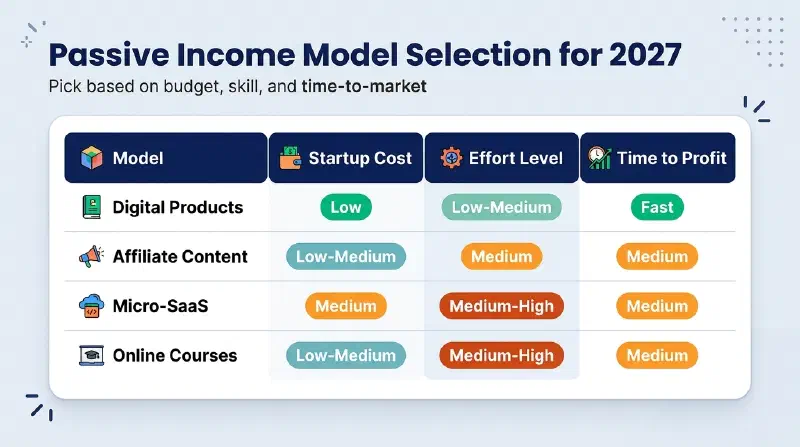
There is no universally best passive income model. The right choice depends on your skills, available capital, time, experience, and willingness to handle ongoing responsibilities.
| Your starting point | Models worth exploring |
|---|---|
| Low budget + writing skills | Niche blog, affiliate content, eBook |
| Low budget + design skills | Digital products, licensed assets |
| Technical skills | Micro-SaaS, automation tools |
| Teaching experience | Online courses, eBooks, educational videos |
| Existing audience | Paid newsletter, courses, templates |
| Investable capital | Diversified investments, property research |
| Product research skills | Affiliate marketing, comparison website |
| Creative skills | YouTube, digital assets, print-on-demand |
How to Evaluate a Passive Income Idea Before Starting#
Before spending months on a project, evaluate whether it is financially and practically viable.
Consider these five questions.
1. Is There Real Demand?#
Find evidence that people want the product or service.
Research:
- Search queries.
- Customer reviews.
- Competitor products.
- Community discussions.
- Existing purchases.
- Questions people repeatedly ask.
Interest in a topic is not always the same as willingness to pay.
2. Can You Reach the Target Audience?#
A product can be excellent and still fail if potential customers cannot discover it.
Identify your distribution channels before building the asset.
Possible channels include search engines, marketplaces, YouTube, Pinterest, newsletters, social media, and partnerships.
3. What Are the Actual Costs?#
Estimate both initial and recurring expenses.
| Expense category | Examples |
|---|---|
| Development | Design, programming, editing |
| Platforms | Marketplace or hosting fees |
| Marketing | Advertising and promotion |
| Infrastructure | Hosting, storage, software |
| Payments | Transaction and processing fees |
| Maintenance | Updates, repairs, support |
| Legal and tax | Applicable compliance expenses |
4. How Will You Measure Success?#
Define a measurable first milestone.
Examples include:
- First digital product sale.
- First paying software customer.
- First qualifying affiliate conversion.
- First 100 email subscribers.
- First 1,000 relevant video views.
These milestones help you evaluate progress without relying on unrealistic income promises.
5. Can the Model Scale Without Increasing Your Work at the Same Rate?#
A reusable digital product may serve more customers without requiring proportionally more production work.
A software subscription may support additional customers through automation, but infrastructure and support costs can still grow.
Understand what happens when demand increases.
How to Calculate Whether an Income Idea Is Worth Pursuing#
Revenue alone does not tell you whether a business is profitable.
You should estimate costs, conversion rates, margins, and the number of sales required to cover expenses.
Example 1: Digital Product Break-Even Calculation#
Suppose:
- Product price: $10.
- Net amount retained per sale after marketplace and payment fees: $8.
- Monthly fixed business expenses: $80.
Your break-even sales volume is:
$80 ÷ $8 = 10 sales.
You need 10 sales to cover the assumed $80 in fixed monthly expenses.
This calculation does not include the value of your own time or any additional taxes and expenses.
Example 2: Subscription Software#
Suppose:
- Monthly subscription price: $15.
- Paying customers: 50.
- Gross monthly recurring revenue: $750.
Now subtract:
- Hosting.
- Database and storage.
- Payment processing.
- Email and monitoring services.
- Customer support.
- Marketing.
- Refunds and failed payments.
This produces a more realistic view of the business than looking at subscription revenue alone.
Example 3: Affiliate Content#
Suppose an article attracts 1,000 relevant monthly visitors.
Assume:
- 80 visitors click an affiliate link.
- 4 make qualifying purchases.
- Each purchase generates a $25 commission.
The article generates:
4 × $25 = $100 in illustrative gross commissions.
You can then test whether improving the article, matching search intent, or recommending a more relevant product improves performance.
Important Metrics to Track#
| Metric | What it tells you |
|---|---|
| Visitors | How many people reach your content |
| Conversion rate | How many visitors take the desired action |
| Average order value | Average amount spent per order |
| Revenue per visitor | Revenue relative to traffic |
| Customer acquisition cost | Cost to acquire a customer |
| Gross margin | Revenue remaining after direct costs |
| Refund rate | How often customers request refunds |
| Retention or churn | Whether customers continue paying |
| Net profit | What remains after expenses |
A project can have impressive traffic and still lose money. Track the metrics that reflect actual business performance.
How to Use AI to Build Passive Income in 2027#
AI can make several business tasks faster, but it should support a business model rather than replace one.
1. Research and Planning#
AI can help you:
- Organize customer feedback.
- Group common problems.
- Create research checklists.
- Compare product features.
- Develop content outlines.
- Identify gaps in existing documentation.
Always verify important claims using reliable sources.
2. Digital Product Development#
AI can assist with:
- Brainstorming product concepts.
- Drafting instructions.
- Creating initial design concepts.
- Generating spreadsheet formulas.
- Checking content consistency.
- Preparing product descriptions.
You still need to inspect the final product for accuracy, originality, quality, and licensing issues.
3. Blogging and Publishing#
AI can help with:
- Outlining articles.
- Organizing research.
- Improving readability.
- Generating interview questions.
- Creating supporting examples.
- Reviewing content structure.
Avoid publishing large volumes of generic pages without adding original value.
4. Software Development#
AI coding tools can assist with:
- Prototyping.
- Code generation.
- Test creation.
- Documentation.
- Debugging.
- Repetitive development tasks.
However, generated code requires review, testing, security checks, and maintenance.
5. Video Production#
AI tools can assist with:
- Script development.
- Storyboarding.
- Captions.
- Voice generation.
- Visual concepts.
- Editing workflows.
The final content should still be accurate, engaging, and useful.
The key principle: AI can reduce production effort, but it does not automatically provide customer demand, trust, distribution, or a profitable business model.
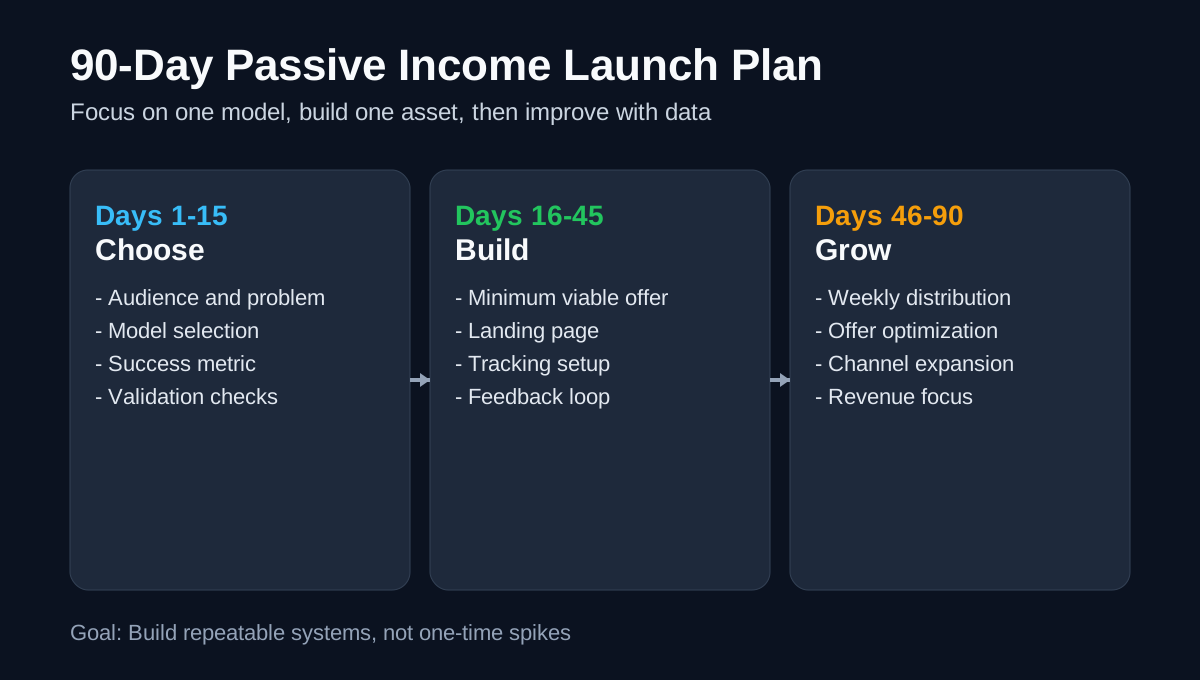
90-Day Execution Plan: Build Your First Income Asset#
Rather than trying to launch several businesses at once, choose one model and test it properly.
Days 1–15: Research and Validate#
Your goal is to confirm that a real audience has a problem worth solving.
Tasks:
- Choose one business model.
- Define your target audience.
- Research existing alternatives.
- Identify customer complaints and unmet needs.
- Estimate startup and ongoing costs.
- Identify payment and platform requirements.
- Define one measurable first milestone.
Examples of first milestones:
- First digital product sale.
- First paying software customer.
- First 100 email subscribers.
- First qualifying affiliate conversion.
- First 1,000 relevant video views.
Do not treat these examples as guaranteed outcomes.
Days 16–45: Build the First Asset#
Create the smallest useful version of your product or content asset.
For a digital product, create one complete product.
For a blog, publish a small group of well-researched articles around one topic.
For a SaaS tool, build the core workflow rather than a large collection of features.
For a YouTube channel, create a small batch of useful videos.
For an eBook, complete the manuscript, editing, cover, and formatting.
The objective is to publish something real that people can evaluate.
Days 46–90: Launch, Distribute, and Improve#
Choose one or two distribution channels.
Possible channels include:
- Google search.
- Pinterest.
- YouTube.
- Relevant communities.
- Email.
- Professional social networks.
- Marketplace search.
Do not spend money on every marketing channel at once.
Track where visitors come from and which sources produce meaningful actions.
Review the results:
- Are people discovering your asset?
- Are they engaging with it?
- Are they purchasing or subscribing?
- What objections do they have?
- Which marketing channel is most useful?
- What is costing more than expected?
- What should be improved or removed?
Use these answers to decide whether to continue, reposition, or test a different approach.
What Should You Expect After 90 Days?#
The objective is not necessarily to replace your salary in three months.
It is to establish whether your chosen model has a realistic path toward sustainable revenue.
A validated small business is a stronger starting point than several unfinished projects.
Common Mistakes That Kill Passive Income Projects#
1. Expecting Immediate Results#
Most income-generating assets need time to attract customers.
A newly published website, book, product, or video channel may not generate meaningful revenue immediately.
2. Starting Too Many Projects#
Trying to build a blog, YouTube channel, SaaS product, digital product store, and newsletter simultaneously can spread your attention too thin.
Choose one primary model and learn from its results.
3. Confusing Revenue With Profit#
A business generating $1,000 in sales may have substantial expenses.
Always calculate the amount remaining after costs.
4. Ignoring Distribution#
Creating an excellent product is only part of the work.
Customers need a way to discover it. Marketing, search visibility, partnerships, and audience building are essential.
5. Depending on One Platform#
Marketplace policies, search algorithms, advertising rules, and payment arrangements can change.
Where legally and appropriately permitted, build an audience relationship you can maintain, such as an email list.
6. Using AI Without Quality Control#
AI-generated material can contain errors, repetition, weak reasoning, and unsupported claims.
Review everything before publishing or selling it.
7. Ignoring Intellectual Property#
Do not copy designs, books, images, software, trademarks, or other people’s work.
Check commercial-use rights and licensing conditions before using third-party material.
8. Treating Investments as Guaranteed Income#
Investment values and distributions can change. Understand the risks before committing money.
9. Ignoring Taxes and Local Requirements#
Income may create tax, reporting, licensing, or business-registration obligations.
These requirements vary by country and business type. Research the rules that apply to your situation.
SEO Notes for Publishers (On-Page + Off-Page)#
If you are building a niche blog as a passive income asset, SEO can help people discover your content through search engines.
However, SEO is not simply adding keywords to an article. It involves understanding search intent, producing useful information, maintaining website quality, and building a trustworthy resource.
On-Page SEO Checklist#
- Use a clear title that matches the reader’s search intent.
- Write a useful introduction that answers the main question.
- Organize content using descriptive headings.
- Include practical examples and relevant comparison tables.
- Add original explanations rather than repeating other articles.
- Use descriptive image alt text.
- Link naturally to relevant internal articles.
- Include authoritative external sources for important claims.
- Review the content for accuracy and outdated information.
- Answer relevant beginner questions in the FAQ section.
Relevant AR Tech Finder resources include:
- AI Productivity Tools for 2027
- Best Lead Generation Tools for 2027
- Modern Web Scraping in 2027
- AI Video Generators 2027
Off-Page SEO Checklist#
- Share articles in relevant communities where they genuinely help readers.
- Earn backlinks through original research and useful resources.
- Build topic clusters around related subjects.
- Develop relationships with relevant publishers and creators.
- Promote useful content through appropriate social platforms.
- Update articles when market conditions, eligibility, and pricing change.
Avoid buying low-quality backlinks or publishing content solely to manipulate search rankings.
Final Thoughts: Build Assets, Not Just Side Hustles#
Passive income in 2027 is not about discovering a secret website or an automated money-making trick.
It is about creating something useful that can continue delivering value after the initial work.
A digital product can serve multiple customers. A helpful article can answer recurring questions. An educational video can continue teaching. A focused software tool can solve the same problem for many businesses.
But every model has costs, risks, competition, and ongoing responsibilities.
Start with one audience, one problem, and one income model. Validate demand before investing heavily. Track actual profit rather than attractive revenue figures. Improve the asset using real customer feedback.
The most valuable income stream is not necessarily the one that promises the most money. It is the one you can build, maintain, and improve consistently.
Frequently Asked Questions#
1. What is the best passive income idea for 2027?#
There is no universally best option. Digital products, niche websites, affiliate content, YouTube, and micro-SaaS can be worth exploring depending on your skills, audience, budget, and ability to maintain the asset.
2. Can I start passive income with no money?#
Some models have very low financial startup costs, including writing, educational content, and basic digital products. However, you still need time, skills, and access to suitable tools and distribution channels.
3. How long does it take to earn passive income?#
It depends on the model, demand, competition, and marketing.
Some digital products may receive a first sale relatively quickly, while a niche website or video library may require months of consistent work to build an audience.
There is no reliable universal timeline.
4. Can AI create passive income automatically?#
AI can help create products, write drafts, generate code, and automate repetitive tasks.
It cannot guarantee demand, customer trust, sales, or long-term profitability. A sustainable business still requires strategy, quality control, and distribution.
5. Is blogging still worth starting in 2027?#
Blogging can still be useful when it provides original, detailed, and helpful information.
A blog should solve specific reader problems rather than publish generic articles designed only to attract search traffic.
6. Is affiliate marketing still profitable?#
Affiliate marketing can generate commissions when relevant visitors trust your recommendations and purchase through qualifying links.
Results depend on audience quality, product suitability, commission terms, conversion rates, and competition.
7. Can developers build passive income?#
Yes. Developers can create software tools, templates, APIs, plugins, automation products, and educational resources.
However, software products usually require ongoing maintenance, support, and security updates.
8. Is Amazon KDP a passive income business?#
KDP can distribute digital and print books without requiring authors to personally fulfill each order.
Authors still need to research, write, edit, format, publish, promote, and update their books.
9. Is rental property completely passive?#
No. Property ownership involves maintenance, vacancies, tenants, legal responsibilities, and expenses.
A property manager can reduce the owner’s workload but also reduces net income.
10. Should I build multiple income streams at the same time?#
It is usually better to validate one business model first.
Once it has a repeatable process and manageable workload, you can explore related income streams.
11. Which passive income model is suitable for beginners?#
Digital products, blogging, eBooks, and affiliate content can be accessible starting points because they can be launched without substantial physical inventory.
The best choice still depends on your skills, target audience, and ability to reach customers.
12. Is passive income guaranteed?#
No. Revenue can fluctuate, platform rules can change, competitors can enter the market, and customer demand can decline.
Treat every income model as a business or investment with risks rather than a guaranteed source of money.
Editorial note: This guide is educational and does not provide legal, tax, or personalized investment advice. Earnings are not guaranteed. Platform fees, eligibility requirements, payment availability, and regulations can change. Verify current terms with the relevant provider before making business or financial decisions.